Types of Light Bulbs: Which One Is Right for You?
The main types of light bulbs are LED, incandescent, halogen, CFL, fluorescent tube, and smart bulbs. For most rooms, an LED is the best default because it uses little electricity, lasts a long time, and comes in many brightness and color options. The right choice still depends on your fixture, dimmer, desired light quality, and power source.
Key Takeaways - LED bulbs fit most lamps and fixtures and use the least energy for the light they produce. - Incandescent and halogen bulbs create warm, familiar light but use more electricity and run hot. - CFL and fluorescent bulbs work well in some utility spaces but contain a small amount of mercury. - Smart bulbs add app, voice, scheduling, and color controls, but need compatible fixtures and a stable connection. - Choose bulbs by lumens, base, fixture rating, dimming needs, and color temperature, not watts alone.
Types of light bulbs explained: the differences that matter
Light bulb types differ in the way they make light. That affects energy use, heat, lifespan, dimming behavior, color choices, and where you can safely use the bulb.
Start with the fixture. Check the bulb base, the shape that fits under the shade or inside the globe, and the maximum wattage label inside the fixture. A lower-watt LED can safely replace a higher-watt incandescent only when it has the correct base and is rated for the fixture's setting.
Then think about these practical factors:
- Lumens: The amount of visible light a bulb produces. More lumens means more brightness.
- Watts: The electricity a bulb uses. Watts do not reliably tell you brightness across bulb technologies.
- Color temperature: The appearance of the light, measured in Kelvin. Around 2700K is warm and yellowish. Around 5000K is cooler and whiter.
- Dimming: A bulb and dimmer must be compatible. Not every LED or CFL dims.
- Enclosed-fixture rating: A bulb inside a sealed globe traps heat. Use a bulb specifically rated for enclosed fixtures.
- Damp or wet location rating: Covered porches, bathrooms, and outdoor fixtures need the correct rating for moisture exposure.
The familiar medium screw base is common in US household lamps, but it is not universal. Small candelabra bases, pin bases, twist-lock bases, and tube connections need a matching bulb. Turn off power and let the old bulb cool before checking what you need.
Light bulb comparison at a glance
This light bulb comparison shows where each option tends to make the most sense. Actual performance varies by the specific bulb, fixture, and settings.
| Type | How it makes light | Energy use | Heat output | Typical strengths | Main drawbacks | Best places to use it |
|---|---|---|---|---|---|---|
| LED | Semiconductor emits light | Very low | Low | Long life, many colors and shapes | Some need compatible dimmers | Most indoor and outdoor fixtures |
| Incandescent | Heated metal filament glows | High | Very high | Warm light, simple dimming | Shorter life, wastes energy as heat | Specialty lamps and occasional use |
| Halogen | Tungsten filament in halogen gas | High | Extremely high | Crisp light, compact shapes | Gets very hot, uses more energy | Some task and specialty fixtures |
| CFL | Gas and phosphor coating create light | Moderate | Moderate | Efficient compared with incandescent | Contains mercury, delayed warm-up on some models | Open fixtures and utility areas |
| Fluorescent tube | Electric current excites gas in a tube | Moderate | Moderate | Broad, even light over large areas | Fixture and ballast compatibility matter | Garages, workshops, utility rooms |
| Smart bulb | Usually an LED with wireless controls | Low | Low | Scheduling, remote control, color options | Costs more to operate features, connection setup | Bedrooms, living rooms, convenience lighting |
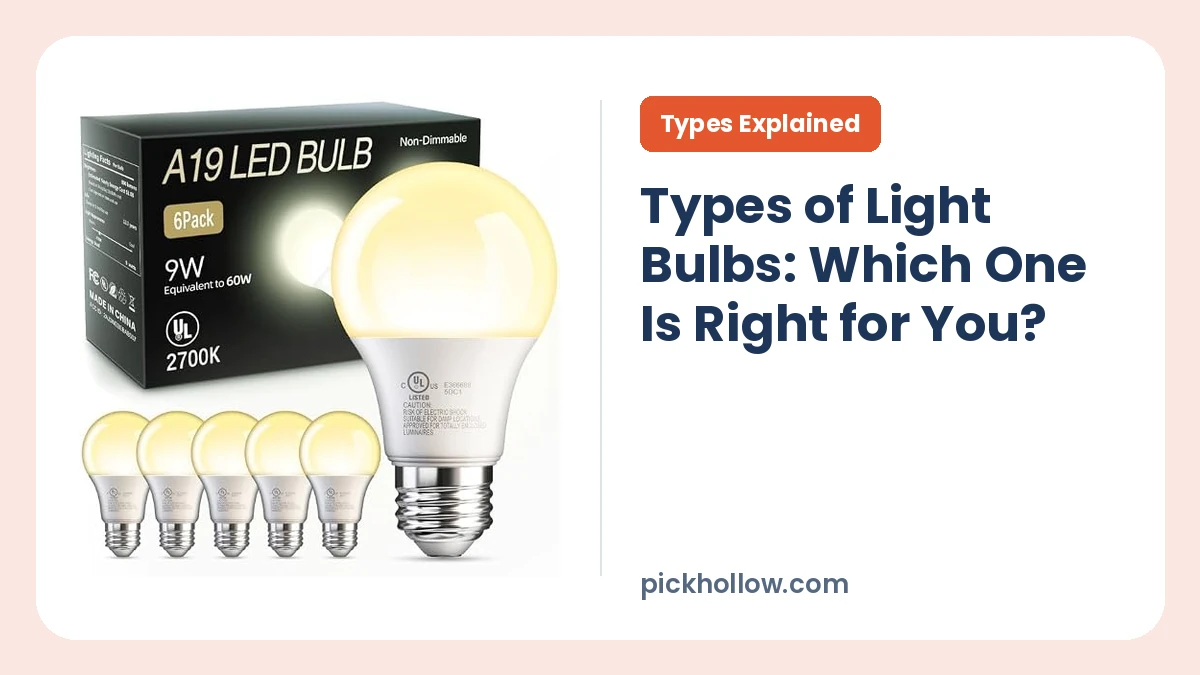
LED bulbs: the practical choice for most homes
LED stands for light-emitting diode. Instead of heating a filament, an LED uses electronic components to produce light. That is why it uses far less electricity than an old-style incandescent bulb with similar brightness.
LED bulbs come in standard A-shape bulbs, globe bulbs, candle bulbs, reflector bulbs, floodlights, tube replacements, and decorative filament-style bulbs. They are also made for outdoor use, appliances, ceiling fans, and enclosed fixtures.
Pros of LED bulbs
- They produce high lumens with low wattage.
- They last much longer than traditional filament bulbs under normal conditions.
- They run cooler, which helps in enclosed lamps and small rooms.
- They turn on at full brightness right away.
- They come in warm, neutral, daylight, and adjustable-color versions.
- Many models work with dimmers when labeled dimmable.
Limits to consider
An LED bulb can flicker, buzz, or fail to dim smoothly with an older dimmer switch. A dimmable bulb still needs an LED-compatible dimmer for reliable results.
Cheap or poorly matched LEDs can also look harsh or make colors appear dull. For living areas, look for a warm color temperature and a color rendering index, or CRI, of 90 or higher when accurate color matters. CRI describes how naturally objects look under a light source.
Best for
LEDs suit nearly every room: kitchens, bedrooms, hallways, bathrooms, porches, ceiling fans, recessed cans, and table lamps. Choose an enclosed-fixture-rated LED for globe fixtures, and use a bulb labeled for the location outdoors.
Incandescent bulbs: warm light with high energy use
An incandescent bulb makes light by sending electricity through a thin tungsten filament. The filament becomes hot enough to glow. Much of that energy becomes heat rather than visible light.
These bulbs create a warm, soft glow that dims smoothly with standard dimmer switches. They have been a common home lighting choice for decades, so many people like their familiar appearance.
Pros of incandescent bulbs
Incandescent bulbs have simple controls and instant light. They work well with many dimmers and give off warm light with excellent color rendering. Decorative versions can add a classic look to exposed-bulb fixtures.
Cons of incandescent bulbs
They use much more power than LEDs and have a shorter service life. They also get hot enough to create a burn risk and add unwanted heat near fabric shades, small lamps, and enclosed fixtures.
Best for
Incandescent bulbs are mainly useful for specialty lighting where their warm dimming behavior is needed and the fixture allows them. Keep clearance around the bulb, never exceed the fixture's wattage limit, and avoid placing high-heat bulbs close to curtains or paper shades.
Halogen bulbs: bright, compact, and very hot
Halogen bulbs are a type of incandescent bulb. They use a tungsten filament inside a capsule with halogen gas. The gas helps the filament burn brighter and last longer than a basic incandescent bulb.
Halogen lighting gives a crisp, bright light and strong color rendering. It has been used in desk lamps, under-cabinet fixtures, floodlights, work lights, and small pin-base lamps.
Pros of halogen bulbs
Halogen bulbs turn on instantly, dim well, and offer clear light for detailed tasks. Small capsules fit compact fixtures where an older LED replacement may not fit.
Cons and safety concerns
The bulb surface becomes extremely hot. Keep it away from curtains, bedding, insulation, and anything flammable. Never touch a quartz halogen capsule with bare fingers. Skin oil can create a hot spot and shorten the bulb's life. Handle replacement capsules with a clean cloth or gloves.
Best for
Use halogen only where your fixture calls for it or where an appropriate LED replacement is unavailable. Check the manual before changing a low-voltage halogen system because it may use a transformer and a specific bulb voltage.
CFL bulbs: efficient spirals with special disposal needs
CFL means compact fluorescent lamp. These bulbs are the curled or folded fluorescent lamps that became popular before LEDs were widely available. They use an electric current through gas inside the bulb, then a phosphor coating changes that energy into visible light.
CFLs use less electricity than incandescent bulbs, but they have largely been replaced by LEDs for everyday home lighting.
Pros of CFL bulbs
A CFL can provide useful brightness with moderate energy use. Many models fit standard household sockets, and some work well in larger open fixtures where the bulb has room to cool.
Cons of CFL bulbs
CFLs contain a small amount of mercury. Do not put them in regular household trash when your local area offers bulb recycling or hazardous-waste collection. Follow local rules for disposal.
Some CFLs take time to reach full brightness, especially in cold spaces. They are also a poor match for frequent switching, fully enclosed fixtures, and many dimmers unless the label specifically says otherwise.
Best for
A CFL can still be practical in a basement, laundry room, or utility area when you already have compatible bulbs on hand. For a new purchase, an LED usually gives you easier dimming, instant light, and simpler long-term use.
Fluorescent tube lights: broad light for work areas
Fluorescent tube lights are longer lamps used in ceiling fixtures. You may see them in garages, workshops, kitchens, utility rooms, and older office-style fixtures. Common tube sizes include T8 and T12, where the number describes the tube diameter in eighths of an inch.
A fluorescent fixture uses a ballast, a device that controls the electrical current. Older systems may also use a starter. This is why tube replacement is not always as simple as matching length alone.
Pros of fluorescent tubes
Tube fixtures spread light across a wide area. They work well above workbenches and in garages, where a single point-source bulb can leave dark corners. They can produce a lot of lumens without using as much electricity as older incandescent lighting.
Cons of fluorescent tubes
Some tubes flicker, hum, or start slowly in cold weather. Like CFLs, traditional fluorescent tubes contain mercury and need proper disposal. Ballast failures can also cause flickering, dark tube ends, or failure to start.
Best for
Fluorescent tubes remain useful in existing shop and utility fixtures. LED tube replacements are available, but compatibility matters. Some work with the existing ballast, while others require bypassing or removing it. Electrical modifications should follow the tube instructions and local electrical rules.
Smart bulbs: LED lighting with extra controls
Smart bulbs are LED bulbs with built-in wireless control. Depending on the model, you can turn them on from a phone, set schedules, adjust brightness, change color temperature, or choose colored light. Some connect through Wi-Fi, while others use Bluetooth, Zigbee, Thread, or a separate hub.
Smart features do not make a bulb brighter by themselves. You still need to compare lumens, bulb shape, base type, and fixture rating.
Pros of smart bulbs
Smart bulbs can make daily routines easier. A schedule can turn porch lights on before sunset or dim bedroom lighting before bed. Color-changing bulbs can shift from warm white for relaxing to cooler white for tasks.
They are helpful for fixtures controlled by a hard-to-reach switch, lamps used on a regular schedule, and homes where you want basic lighting control without rewiring.
Cons of smart bulbs
A smart bulb needs constant power. Turning off the wall switch cuts its connection and prevents app or voice control. For that reason, smart bulbs can frustrate people in rooms where others regularly use the wall switch.
They also need setup, updates, and a supported control system. Choose a bulb that works with the phone platform, voice assistant, or hub you already use.
Best for
Smart bulbs work best in lamps, bedrooms, living rooms, entryways, and outdoor fixtures rated for the bulb's environment. They are less useful for lights you simply flip on for a few minutes, such as a closet or basic utility fixture.
Power source and fixture compatibility come first
A bulb's power source must match the fixture. Most household bulbs use standard 120-volt AC power. Other fixtures use low-voltage systems, batteries, solar panels, or plug-in transformers. A bulb designed for one system can fail or create a hazard in another.
Low-voltage landscape lights and certain halogen fixtures commonly use 12 volts. Some specialty bulbs operate on other voltages. Read the markings on the old bulb, fixture label, and transformer before buying a replacement.
Outdoor solar lights are a separate category. Their small LED is powered by a rechargeable battery charged through a solar panel. They are convenient for path marking, but brightness depends on panel exposure, battery condition, and daylight hours.
Also check these fixture details:
- Base type: The base must match exactly. Do not force a bulb into a socket.
- Physical size: A globe or reflector bulb can be too wide or too tall for a shade.
- Maximum wattage: Follow the fixture label, even with efficient bulbs.
- Dimming requirement: Pair a dimmable bulb with the right dimmer.
- Location rating: Use damp- or wet-rated lighting where moisture is present.
- Enclosure rating: Use bulbs marked safe for enclosed fixtures inside sealed globes.
Which light bulb is right for me?
For most people, the answer is a dimmable LED in the right base, shape, brightness, and color temperature. The other different kinds of light bulbs make sense in specific fixtures or for specialty needs.
Use this quick decision guide:
- You need an everyday bulb for a lamp or ceiling fixture: Choose an LED with the brightness and warm or cool tone you prefer.
- You want a dimmable bedside or dining light: Choose a dimmable LED and confirm your wall dimmer supports LEDs.
- You need clear light for a vanity, craft table, or kitchen: Choose an LED with high CRI and enough lumens for the task.
- You have an old fluorescent shop fixture: Keep compatible fluorescent tubes or switch to an LED tube designed for that fixture.
- You want schedules or phone controls: Pick a smart LED that works with your existing home controls.
- Your fixture requires a small capsule or specialty bulb: Match the voltage, base, and fixture instructions exactly before considering halogen or LED replacements.
Do not use watts as your main brightness guide. For example, two LEDs with the same wattage can produce different lumens. Read the Lighting Facts label or package to compare light output, estimated energy use, color temperature, and dimming information.
Make your final choice with a five-minute check
Before buying a replacement, take a photo of the old bulb and the fixture label. Measure the widest part of the bulb if it sits under a tight shade. This prevents the common mistake of bringing home a bulb that fits the socket but not the fixture.
Choose your brightness in lumens, then choose the light appearance. Warm white works well in bedrooms and living rooms. Neutral to cool white helps with detailed tasks. For an LED in a closed globe, confirm the package says it is suitable for enclosed fixtures.
A good lighting plan can use more than one type of bulb, but LED options cover most needs safely and efficiently. Match the bulb to the fixture first, then choose controls and light quality that suit the room.
Frequently Asked Questions
Are LED bulbs always the best choice?
LED bulbs are the best choice for most home fixtures because they use little electricity, last a long time, and come in many brightness levels. A specialty fixture may need a particular base, voltage, size, or dimming behavior. Read the fixture label before replacing an unusual bulb.
How many lumens do I need for a standard room?
The right lumens depend on room size and the task. A table lamp may need a few hundred lumens, while a kitchen or work area needs much more total light from several fixtures. Add the lumens from all bulbs in the room instead of relying on one bright bulb.
Can I use an LED bulb in an old lamp?
Yes, you can use an LED in an old lamp when the base fits and the bulb physically clears the shade. Choose a bulb with wattage below the lamp's maximum rating. In a lamp with a dimmer, use a dimmable LED and an LED-compatible dimmer switch.
Why do LED bulbs flicker on a dimmer?
LED bulbs flicker when the bulb and dimmer do not work well together. Older dimmers were designed for incandescent loads and may not deliver stable power to LEDs. Install a compatible LED dimmer, confirm the bulb is dimmable, and keep the dimmer within its stated load range.
Do CFL and fluorescent bulbs need special disposal?
Yes, CFL and fluorescent bulbs need special disposal because they contain a small amount of mercury. Do not intentionally break them or put them in a fire. Use a local household hazardous-waste program or bulb recycling option where available, and follow local instructions for broken bulbs.
Can I put a smart bulb in any light fixture?
You can put a smart bulb in a compatible fixture with the correct base, voltage, and location rating. It also needs constant power to stay connected. Avoid using one in a fixture controlled by a switched outlet or a wall switch that people turn off frequently.